Winter 25/26
Is it over yet? Nope, it's gonna take more than a minute.

Why did so many not see it?
As fall gave way to winter, that question perplexed me, fascinated me, appalled me. If you knew some history, if you understood how the government was supposed to work, how relations among industrial nations had been delicately balanced for 75 years, Trump’s trampling of the norms of democracy was a five alarm fire. The blatant corruption, the lawlessness and cruelty of ICE, the trashing of allies and the admiration of tyrants. All of it, the insults, the lies, the pettiness, the narcissism, the gross ineptitude. I mourned the loss of Reagan’s shining city on a hill, that vision of America as a beacon of hope, an aspirational ideal for all people. (Trump had me nostalgic for Reagan, fer chrissakes. At least he knew what made the United States extraordinary).1
That fall, we’d become a pirate nation, blowing up boats and murdering their occupants, seizing oil tankers and confiscating their cargos.2 Trump didn’t bother offering proof that the boats were ferrying lethal drugs to the US as an act of war devised by the Maduro government. He simply declared it, and that was enough for millions of Americans. The many rebuttals from lawyers and journalists who knew the substance of the law and the realities of the drug trade made clear that these boats posed no threat to the US. The people we killed were not enemy combatants. But MAGA didn’t read those. It was fake news. A few Republican Senators roused themselves enough to bleat expressions of concern.
The slow-walking of the Epstein files continued, an unease that rippled beneath the daily outrages. The drip, drip, did nothing but fuel more speculation. What was the administration trying to hide? What was awful enough for Trump and his people to go to such lengths? Even when Congress finally managed to pass a law requiring their release, the administration dragged. Hoping, were they, that eventually the issue would go away? Or were they just trying to run out the clock? It didn’t seem to matter. When the big release finally came, full of redactions, nobody was satisfied and nobody’s opinions were changed.
Marjorie Taylor Greene, the preeminent embodiment of MAGA in Congress, broke with Trump and dramatically announced her resignation. The news rippled through the chattering classes, people wondering if and how and why she’d changed. Like many in the movement, Greene was intelligent enough, ambitious and energetic, but profoundly ignorant of anything outside her bubble and with a natural gullibility and naiveté that made her an easy mark. All her life she’d vaguely wanted to make a difference and to be celebrated for it. Like so many others who’d become unmoored from reliance on traditional sources of facts and truth, she’d embraced QAnon and its terrifying descriptions of pedophile Democratic elites. It horrified her and gave her a mission, one that brought this previously apolitical woman into Congress. By the time she got there, her views had softened. She defended herself, apologizing before the House that she, like so many others, “had been allowed to believe” so many things that weren’t true.3 The phrase stuck with me, and I often wondered why no one had ever asked who it was that had “allowed” that to happen and how she thought it might have been prevented. Her break with Trump came only as she saw Congress abandoning, or at best dragging its feet on, what she believed were core MAGA principles, the Epstein files chief among them. She knew that once Trump branded her a traitor and promised to primary her, he’d made her a target. It wouldn’t be safe to campaign with the fire of Trump’s rage turned against her. And Congress had been a disappointment anyway.
Some saw this as a sign of schism within MAGA, evidence of Trump’s weakening, but I’d seen too many times people trumpeting that this or that would be the last straw. It never was. The best estimates numbered hardcore MAGA as some 50 million American adults – maybe 16% to 20% out of 275 million. They would never abandon their hero. Whatever Trump declared MAGA or America First to be, they would follow him without hesitation, even if it meant repudiating things they’d feverishly believed not six months before. MTG’s stand was worth a few speculative pieces in the news, and then she was gone.
The polls showing Trump’s dwindling support enraged him, isolated as he was in his bubble of sycophantic praise. Fake news! He threatened to prosecute the pollsters and sue the news sites. Hemispheric imperialism juiced him up, pumped his megalomania. He was asked if there were any limits to what he might do and he calmly replied, “Yeah, there is one thing. My own morality. My own mind. It’s the only thing that can stop me.” Could anything sound more terrifying?
Stephen Miller made it clear. “We live in a world in which you can talk all you want about international niceties and everything else, but we live in a world, in the real world, Jake, that is governed by strength, that is governed by force, that is governed by power. These are the iron laws of the world since the beginning of time.”4 I feared that too many people believed it. I heard echoes of the famous Ron Suskind article from 2004, an aide to W proclaiming that we were an empire now, “and when we act, we create our own reality.”5
Was this why there was so little outrage? That it had been decades since people trusted the government, that they’d come to believe that all politicians lied, that it was only money and power (and you could never untangle the two) that mattered? So that what Trump was doing wasn’t any radical shift from politics as usual, it was just making blatant what had always been going on behind the scenes? So that the only sensible thing to do was to keep your head down and try to lead the best life you could for yourself and your family?
There were occasional feeble signs of restlessness among the Senate Republicans. After Trump’s brazen kidnapping of Maduro, a resolution to bar him from sending troops to Venezuela came close to passing. But not quite. The fig leaf that the US was trying to restore democracy gave way to the true thrust of the enterprise. The objective had always been oil. Machado, the opposition leader, came to Washington and gave Trump her Nobel medal. It made no difference. Trump wanted stability, not democracy, in Venezuela. The country would need to be “fixed” before Trump would allow elections. In the meantime, Maduro’s government would remain in place as long as they cooperated. Thuggery as foreign policy.
Even the murder of Renee Good seemed at first to do little to shift attention or positions. The President immediately claimed that the shooter had been run over and was in the hospital fighting for his life. His minions echoed him with only slightly less outrageous falsehoods. But even the shooter’s own cell phone video, released by DHS to support their narrative, showed that Good was clearly no threat and was attempting to turn away from him when the first shot was fired. Undeterred, Trump’s supporters continued their holler that the fault was entirely the victim’s and the killing perfectly justified. The Justice Department barred local law enforcement from the investigation, intent on maintaining complete control of the story. The resistance intensified. Minds may not have been changed, but more people were filling the streets.
ICE became more reckless, more violent. The brutality was being captured on video and widely shared, but I didn’t see many minds being changed. The rhetoric escalated. At an appearance at an auto plant one of the line workers shouted “pedophile protector” as Trump was leaving. Trump gave him the finger, yelled “Fuck you! Fuck you!” When, in mid-January, he threatened to invoke the Insurrection Act, it wasn’t a surprise, but my stomach curdled.
It had only taken him a year. The fascist dictatorship had arrived. And still, millions of Americans refused to see it.
Trump had elevated the Lie to the most extravagant and effective tool of politics. Propaganda had always involved the systematic use of falsehoods, but the art was to shape it into a semblance of truth, subtly twisting the evidence to achieve the desired result. Trump’s crude brilliance was to realize that subterfuge was no longer necessary. With no shared consensus for determining truth, he could say whatever he wanted people to believe and enough of them would, because they had latched on to him as the arbiter of their truth and every attempt to present evidence of his lying was easily dismissed as “fake news”. His team pumped out an endless stream of crudely juvenile memes, disparaging anybody who couldn’t take the joke.
Trump’s attention shifted again, back to Greenland. Many people saw his bounding from outrage to outrage as a means of diverting attention from Epstein, or from ICE, or from whatever seemed to be creating the most negative press at the moment. I thought that gave him too much credit. I saw the desperate flailing of a madman, drunk with power, convinced that he could control the countries of the world by issuing more Executive Orders, threatening more tariffs.
Trump went to Davos blustering about taking Greenland by force and imposing massive punitive tariffs on any country that dared object. There was the usual whiplash effect when he then casually dismissed any armed invasion of Greenland and dropped the tariff threat after a private conversation with the NATO Secretary General. He claimed there was now a framework for dealing with Greenland and everybody would be very happy. But nobody seemed to know what was in this framework. It was typical Trump. Bully and threaten, then back down claiming victory with the promise of a great deal, which never quite came to pass.
On and on the blathering went. The speeches got longer, more unhinged. His advisors wanted him to focus on economic issues, but he was incapable. Except for excoriating the Fed chair, he was bored by economic issues. He repeated the lies that grocery prices were coming down, that gas was under $2 a gallon, that we had the greatest economy ever, and then pivoted to his favorite grievances – the Nobel peace prize, the stolen election, all of the ways in which he had been so badly treated. Did he believe the things he was saying? I wondered. But then I thought that normal categories of belief, just like norms of truth and falsity, couldn’t be applied to Trump. He was living a delusion, truth and lies just shimmers that shifted with his moods, with whoever had flattered him the most the most recently.
None of this was enough to rouse the Republicans in Congress. Nothing was enough to persuade MAGA that the movement had gone terribly wrong. The United States had lost its place in the world order, had jettisoned the guiding principles that had made it the envy of the world, but Senators and Congressmen cowered in fear and MAGA exulted in the brutality.
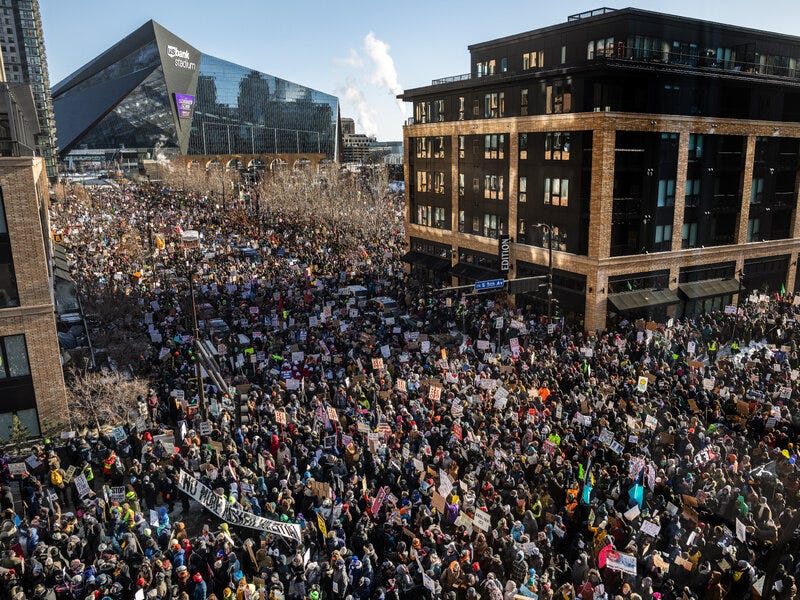
That January a massive winter storm brought snow and ice to much of the country. Still, even in sub-zero temperatures, thousands stayed in the streets of Minneapolis, organizing, protesting, observing, recording. Then, another killing. This time with no ambiguity. The Lie couldn’t stand against the videos showing all too clearly that Alex Pretti never reached for his gun and had been disarmed before the shooting started. Trump, Noem, Bovino screamed “domestic terrorist!” planning to “massacre” ICE agents! But the Lie had started to crack. Trump chose a strategic retreat. You could almost hear Miller grinding his teeth, so eager he’d been for a full on assault. But Trump talked to the Governor and the Mayor, agreed to draw down his forces a bit, improve coordination with local officials. Bovino was demoted and sent to California. Homan would be in charge, reporting directly to Trump. Noem, now sidelined, was surely livid. How she must’ve loved Bovino’s military manliness radiating from his ghoul’s grin, his spiky hair and the glorious intimidation of his olive green greatcoat. But she wasn’t as deft at wielding the Lie as the Master and her clumsiness had caused too much of a backlash. Homan was a brutal, corrupt thug, but he’d shift the optics and give the President some breathing room.
When I was in my teens, reading history, learning about the rise and fall of empires, I wondered how long the American experiment could last. Now we knew. Trump would plan many celebrations in 2026, recognizing the 250th anniversary of the Declaration. To many Americans, the events would be bitter, marking not the grandeur of a nation dedicated to freedom, but the end of that experiment and the rise of the fascist state.
It was hard to imagine, watching Trump’s meandering, bullying bloviating in Davos that he could make it through three more years. His body would give out or he’d become too erratic for even his own advisors and they’d 25th him6 or the Democrats would take back the House and impeach him and enough Republican Senators would grasp at the chance to convict him and salvage what little self-respect they had left.
None of which gave me any comfort. We’d be left with President Vance. He’d use the tools of absolute power that Trump had established to quell any disruptive protests. Many Americans would breathe a sigh of relief that the erratic buffoon was gone, they’d be grateful for a steady hand. The tech overlords, Vance’s primary backers throughout his rise, would be calling the shots. The very rich would do very well. The rest would continue to struggle as the income gap grew wider. The Christian Nationalists would reshape the government to support their twisted vision of God’s plan. Muslims would serve as the national scapegoat. I conjured a terrifying post-apocalyptic US.
It was the Maduro situation brought home. You might take out the figurehead, but if you left the rest of the government apparatus in place, what’s been gained?
Burned too many times, I expected the worst. I found myself more fearful of what would happen without Trump than of the wreckage he would cause staying in place. Just as Trump had ground his heel into the hopes of Venezuelan democracy, Vance, Wiles, Vought, Miller and the others would do their best to strangle those hopes in the United States.
What Minneapolis made clear was that the war would be long. There was not going to be one moment of reckoning, when the nation rose up against Trump and MAGA and started to reverse the destruction. In Minneapolis, the people won a small victory, and that was worth celebrating. It was still going to be years of skirmishes as Trump pushed the boundaries while the people, some of the people, enough of the people, kept pushing back. But I surprised myself. Grim as my imaginings were, they could not extinguish that muscle of hope. Minneapolis gave me that.
The vision that had been America at its best couldn’t be extinguished, even if it would no longer be guiding the Federal government. It would have to find its expression elsewhere. It would happen in neighborhoods that followed the Minneapolis example of organizing to protect their neighbors, no matter where they’d come from. It would happen in small private colleges, where faculty insisted on teaching true history and the importance of independent thinking. It would happen where local school boards protected school libraries and curricula that encouraged students to explore uncomfortable ideas. It would happen in the daily interactions of neighbors helping neighbors without worrying who they’d voted for. It would happen in the multiethnic urban neighborhoods where so many put the lie to the notion that there is only one way of being a patriotic American, and where the differences in traditions were celebrated. It would happen on the streets where people would continue to arm themselves with whistles and phones. It would happen as normally apolitical citizens set their daily routines aside with disgust, finally finding themselves having to say, “Enough. This has to stop.”7 One day it might even happen in the halls of Congress if elections brought in enough new faces determined to put country before party, but that would be the least important part.
It wouldn’t look the same as it had been. The Constitution was in tatters, its vulnerabilities deftly exploited by those determined to restore an imaginary time when security and stability were maintained by strong white men and everybody knew their place. Our long revered Constitution could no longer protect the vulnerable. Trump had made sure of that. But the ideals it was built on remained. We would have to find new structures of government that embodied and fostered and protected the ideals enshrined in the Declaration of Independence, the principles embedded in that fatally flawed Constitution. What would that look like? How long would it take? No one could say. But it would come.
I believe that the future of democracy in this country will not be decided in the courts
It will not be decided in Congress
It will not be decided on social media
I believe that the future of democracy in this country will be decided right here
On the Streets of Minneapolis8
Reagan laid the groundwork for so much that corrupted the country. But I love this bit from his last official speech, and it seems particularly appropriate to the grievous moment we’re in. Since this is the last speech that I will give as President, I think it’s fitting to leave one final thought, an observation about a country which I love. It was stated best in a letter I received not long ago. A man wrote me and said: “You can go to live in France, but you cannot become a Frenchman. You can go to live in Germany or Turkey or Japan, but you cannot become a German, a Turk, or a Japanese. But anyone, from any corner of the Earth, can come to live in America and become an American.” Ronald Reagan, January 19, 1989.
Trump set up an offshore account for the revenue, and nobody blinked.
Here’s the transcript of her remarks, February 4, 2021. https://www.rev.com/transcripts/marjorie-taylor-greene-house-floor-speech-transcript-hearing-to-remove-greene-from-committee-assignments
The aide said that guys like me were “in what we call the reality-based community,” which he defined as people who “believe that solutions emerge from your judicious study of discernible reality.” I nodded and murmured something about enlightenment principles and empiricism. He cut me off. “That’s not the way the world really works anymore,” he continued. “We’re an empire now, and when we act, we create our own reality. And while you’re studying that reality-- judiciously, as you will -- we’ll act again, creating other new realities, which you can study too, and that’s how things will sort out. We’re history’s actors . . . and you, all of you, will be left to just study what we do.” NYT Magazine, October 17, 2004.
The 25th Amendment requires the VP and a majority of the Cabinet to agree to pull the plug. If POTUS objects, he needs 2/3rds of both Houses of Congress to keep his job.
See, for example, this WaPo article: https://www.washingtonpost.com/technology/2026/01/27/alex-pretti-death-trump-backlash/
Tom Morello, introducing Bruce Springsteen, First Avenue, Minneapolis, January 30, 2026